Deaerators and Condensate Tanks
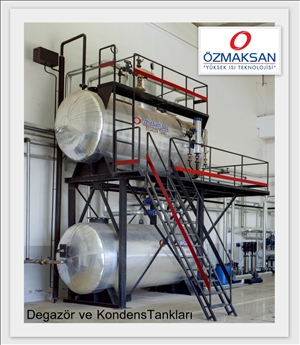
Deaerator and condensate tanks are key components of an installation, supporting its safe and efficient operation. They are responsible for condensate recovery and for reducing energy and heat losses. Robust construction, appropriate insulation and the option of additional equipment allow the units to be tailored to the requirements of a specific installation.
Product description
Deaerator Tanks
Depending on the deaerator type and the boiler house layout, the tanks are manufactured in horizontal or vertical versions as cylindrical structures with dished ends, made of St.37 material. The plate thickness is selected 1–2 mm greater than for standard tanks. To protect against vacuum, the tank interior is reinforced with NPI-NPU sections. Mounting flanges and other necessary connections are located inside the dome. In the case of mixed heating, connection flanges, steam distribution manifolds and pipework are located at the bottom of the tank.
Dissolved oxygen (O₂) and carbon dioxide (CO₂) in the feed water cause corrosion of the metal surfaces of the steam system and the steam boiler. To separate the corrosive gases from the feed water, carbon dioxide is removed at a temperature of approximately 60°C and oxygen at temperatures above 100°C. This is achieved by spraying the water into fine droplets and heating it with steam. In the thermal deaeration system, the water is distributed by means of a spray system.
Deaerator dome: The external surface of the tank and condenser is coated with two layers of anti-corrosion paint. The deaerator dome is insulated with rock wool of suitable density and thickness. Optionally, the tank can be clad with galvanised, aluminium or stainless steel sheet.
Deaerator equipment (optional):
- Pressure reducing valve
- Thermostatic steam valve
- Steam and water connection valves
- Bypass valves
- Level control devices
- Drain valve
- Water outlet valve
- Automatic air vent valve
- Water level gauge glass
- Pressure gauge
- Thermometer
- Equipment is selected with regard to capacity, quality, price, and ease of operation and maintenance.
Condensate Tank
Condensate tanks are installed at the end of the system return line and serve as the central condensate collection point. Steam loses temperature as it circulates, and the resulting condensate is collected in the tank. Condensate tanks prevent thermal shocks caused by temperature drops. They limit energy losses to the atmosphere, helping to increase the energy efficiency of the system. A heating coil allows the feed water to be heated. The water retains its temperature in the condensate tank, resulting in energy savings. In addition, the insulated tank body reduces heat losses.
Type: Cylindrical, horizontal or vertical, with dished ends
Design standard: AD2000 MERKBLATT – EN 13445
Working pressure: 0.2–0.3 bar
Working temperature: 102°C
Insulation: Rock wool or glass wool
Material: Made of P265GH or P295GH boiler plate to EN 10028
- At the customer’s request, the internal and external surfaces of the tank can be blast-cleaned to SA 2½.
- Hydrostatic tests are carried out to check for deformation and to eliminate any leaks.
- Weld inspections, NDT and radiographic testing are carried out.
- The equipment is CE certified by TÜV SÜD.
- Manufacturing complies with the European Pressure Equipment Directive 2014/68/EU.
- Hydrostatic tests are carried out under the supervision of independent, accredited inspection bodies such as TÜV, Lloyd’s Register and Bureau Veritas.
- A TS EN ISO 2001:2015 Quality Management System is applied.
- All our welders are certified by Turkish Lloyd in accordance with EN 15216.
- Our products carry a 2-year warranty against manufacturing defects.